VR Industrial Training: The Complete Guide for Manufacturers


For years, traditional e-learning, slide decks, videos, and quizzes dominated corporate training. But in industrial settings where safety, precision, and rapid skill acquisition are critical, that model is showing serious limitations. Passive modules don’t build muscle memory. Watching a video doesn’t prepare someone for a high-pressure scenario. Forward-thinking companies are moving to immersive VR training that is interactive, scalable, and results-driven.
The limitations of traditional e-learning
Click, watch, forget
Traditional e-learning has its place, but when real-world risk is involved, passive learning isn’t enough. Quizzes and slides can’t simulate the noise, pressure, or complexity of a job site. To build instinctive, hands-on skills, workers need realistic, responsive environments.
That’s where VR can elevate e-learning. Unlike static modules, immersive simulations adapt to each learner, providing real-time feedback and personalized challenges. As such, VR helps close skill gaps more quickly and boost retention, something standard content often struggles to achieve.
Psychologists have shown that people forget up to 80% of passive content within days. But when learners are actively engaged, seeing, doing, reacting in real-world scenarios, they retain more and perform better. VR doesn’t replace e-learning. It enhances it, making training more impactful, more memorable, and more aligned with how people actually learn.
Why immersive tech is changing the game
It’s not just a gimmick
Users engage directly, boosting knowledge retention and improving hands-on skills. Immersive platforms recreate complex, high-risk scenarios in safe, virtual environments. Trainees operate machinery, handle equipment, and make decisions, all without real-world consequences.
Instead of watching, users do. Active learning improves retention and builds confidence in ways static content simply can’t. From manufacturing to construction and energy, organizations using immersive training see real-world impact: faster onboarding, fewer accidents, and better long-term skill retention.

6 Key Applications of VR in Industrial Training
Different training scenarios benefit from VR in different ways. Here are the six most impactful applications used by manufacturers, energy companies, and logistics firms today.
1. Safety Training
High-risk environments demand flawless execution. Real-world emergency drills are expensive, disruptive, and hard to run frequently. VR changes that. Trainees experience realistic emergencies such as fires, leaks, and equipment failures under full pressure, with no real danger. They can practice the same scenario dozens of times until the correct response becomes instinctive.
Example: Shell uses VR to simulate offshore oil rig emergencies, including fuel-tanker fires. Trainees must respond under realistic pressure. The result? Measurable safety improvements and consistent scenario replay.
2. Equipment Operation
Learning complex machinery on the job is expensive and risky. Traditional training requires access to real equipment, which often means shutting down production or risking damage from inexperienced operators. VR eliminates both problems. Workers practice on virtual replicas of actual equipment before touching the real thing.
Example: Volkswagen uses 3D vehicle models in VR to help trainees understand how parts fit together and operate. No production shutdown required.
3. Maintenance and Repair
Technicians need to troubleshoot equipment failures without guessing. But real breakdowns are unpredictable. Waiting for one to happen is no way to train. VR provides hands-on practice with a full range of equipment failures on demand. Technicians learn to diagnose problems, follow repair procedures, and verify fixes in a virtual environment that mirrors their actual workspace.
Example: Caterpillar trains heavy machinery technicians in VR, allowing them to diagnose and fix issues virtually before working on multi-million dollar equipment.
4. New Hire Onboarding
First impressions matter. VR onboarding helps new hires build confidence before day one on the floor. Trainees navigate virtual workspaces, practice standard procedures, and make mistakes safely, before even touching real equipment.
Example: Verizon uses VR to onboard retail employees, allowing them to practice customer scenarios and navigate store layouts before ever setting foot in a physical location. DHL boosted order-picking efficiency by 25% using VR smart glasses for warehouse training.
5. Design and Prototyping
Building physical prototypes is slow and expensive. Making changes after production starts is even worse. VR lets engineers test designs virtually before anything is built. They can spot flaws, test ergonomics, and validate functionality in a fully immersive environment. Changes take minutes instead of weeks. Rework costs drop dramatically.
Example: Ford designers use VR to explore vehicle functionality and ergonomics before committing to physical prototypes.
6. Soft Skills Training
Technical skills aren't enough. Leadership, communication, and teamwork matter too — especially in high-pressure industrial settings.
VR scenarios let employees practice difficult conversations, emergency coordination, and shift handovers in realistic but low-stakes environments.
When to Prioritize VR Training for Your Team
VR training delivers value across nearly any industrial learning scenario. But if you want to focus your budget where the impact is greatest, three specific situations stand out. In each case, VR improves training and helps solve problems that traditional methods cannot touch.
High-Risk Procedures
If your team handles fire hazards, toxic chemicals, or high-voltage equipment, VR is a clear choice. Workers can practice emergency shutdowns or leak containment in a safe virtual environment before facing real danger.
Complex or Expensive Machinery
Training on a CNC machine, robotic arm, or assembly line carries the risk of costly damage. VR eliminates that risk entirely. New operators can learn sequences and troubleshoot problems on a perfect virtual replica of your equipment.
Hard-to-Repeat Scenarios
Some situations, like a major equipment failure or a rare safety incident, are difficult to train for in real life. VR makes these scenarios repeatable on demand. Technicians can practice a once-a-year repair procedure every week until they master it.
Proven Benefits of VR Industrial Training (With Metrics)
While this might all sound good in theory, what do the numbers actually say? We've done some research to save you time, in order to look at some of the most obvious and immediate benefits. Here's what companies actually achieve when they switch from traditional methods to VR.
| Benefit | Metric |
| Fewer injuries | 43% reduction in lost-time injuries after VR safety training |
| Faster training | VR-trained workers complete tasks 30-40% faster than traditionally trained peers |
| Lower costs | 82% of companies implementing AR/VR say benefits exceed expectations |
| Better retention | VR improves knowledge retention from 10% (traditional) to 75% |
| Less equipment downtime | Train without shutting down production lines |
For Employees
Employees gain just as much. They get risk-free practice, making mistakes without real-world consequences. The benefits of the training build overall confidence and keep trainees engaged. They learn faster and can repeat scenarios until every motion becomes second nature.
Most companies already see a return on their VR training investment within the first year thanks to significantly shorter training cycles, fewer incidents, and improved productivity. And from there, the benefits and savings only compound further.

How to bring VR training into your industrial world
1. Headsets are now affordable and user-friendly
VR used to require high-end computers and expensive external hardware. Not anymore. Thanks to major advances in user experience, tracking technology, and standalone headsets, today’s devices are more affordable, portable, and easy to set up, with no base stations, no tangle of cables, and no gaming PC required.
2. Hand tracking makes it accessible for everyone
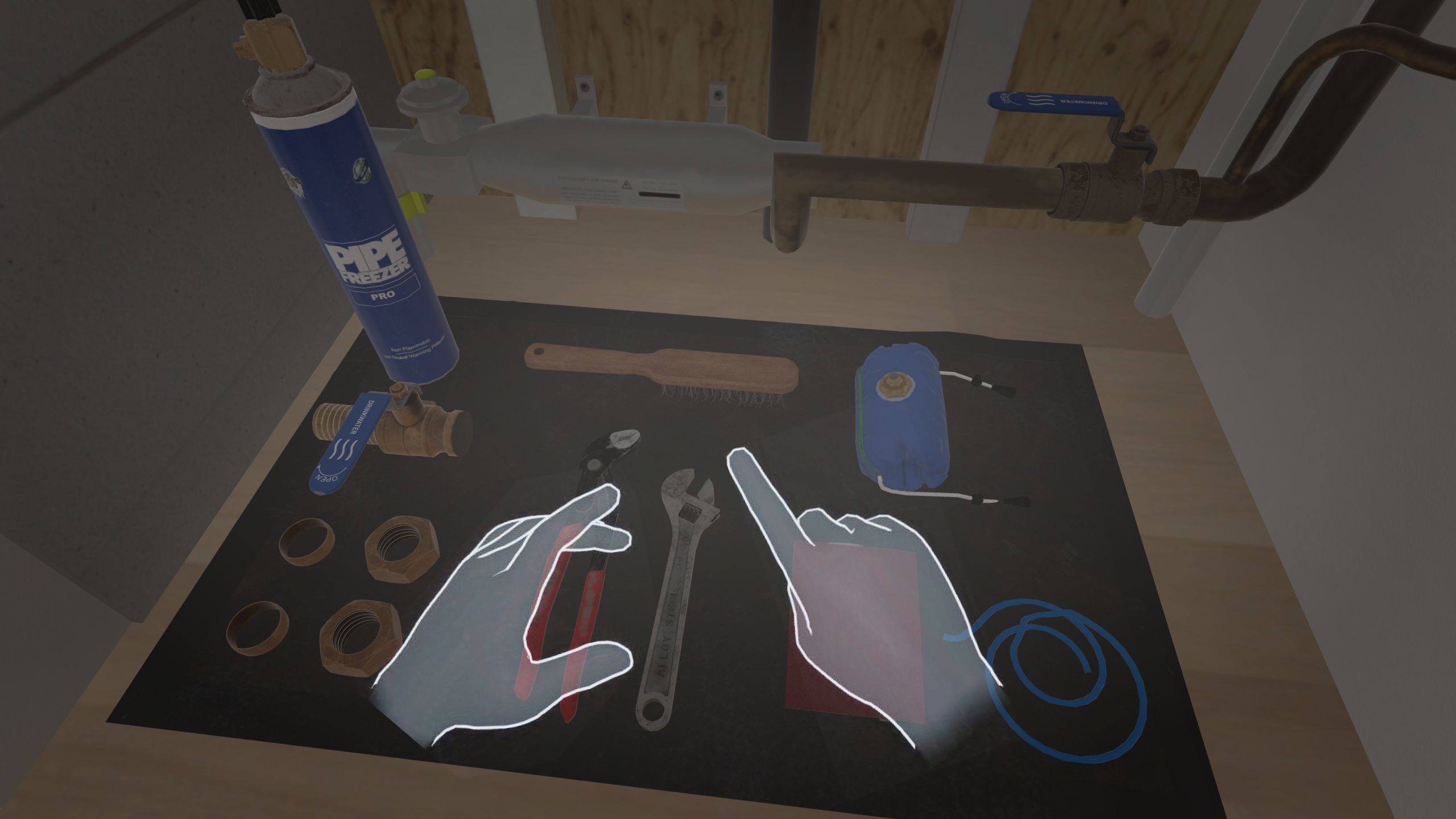
With built-in hand tracking, users no longer need to master gaming-style controllers. The accessibility makes VR training far more appealing to non-gamers and first-time users, as they can just put on the headset and start learning with natural hand gestures.
3. Measurable, actionable insights
Track progress in real time. See who’s trained, who’s mastered specific skills, and where to focus improvement. VR training can integrate with your existing LMS.
What’s next for industrial training?
Smarter, more sensory tech
Think even more personalization, high-fidelity digital twins, and tactile feedback. Training becomes hyper-relevant and intuitive.
For instance, Siemens uses high-fidelity digital twins of factory equipment, combined with VR and AR, to simulate real-world operations. Trainees interact with these virtual replicas, sometimes with haptic feedback gloves, to gain realistic practice without interrupting actual production lines.
A bigger role in knowledge preservation
With industrial processes evolving rapidly, continuous upskilling is essential. Immersive tech enables faster, more effective knowledge transfer than traditional methods.
Honeywell’s Immersive Field Simulator features a VR-based digital twin of industrial plants, allowing new technicians to safely train on real-world scenarios, like equipment faults and emergency protocols, without disrupting operations.
With attrition affecting industrial sectors globally, capturing expert decision-making and processes in VR ensures that decades of know-how aren’t lost. By embedding this expertise into simulations, Honeywell helps new hires retain complex information more effectively than with manuals or lectures alone.

Challenges and Limitations of VR Industrial Training
VR training isn't perfect. Being upfront about limitations builds trust and helps you make the right decision. To start with, a poorly built VR module is worse than no VR at all. Low realism, clunky controls, or irrelevant scenarios will frustrate trainees. Success depends on high-quality content, not just the headset.
Initial Investment Required
While headset prices have dropped (the Meta Quest 3 starts around $500), custom content development still requires an upfront budget. However, most companies recoup this within a year through reduced equipment damage and faster onboarding.
User Comfort and Acclimation
Some workers experience motion sickness or need time to adjust to VR. Not everyone is a "gamer." But modern headsets with hand tracking (no controllers needed) have made VR far more accessible than even two years ago.
Not a Complete Replacement
VR works best as part of a blended learning approach, meaning that combining VR practice with classroom theory and real-world supervised work yields the best results. It's a powerful supplement, not a magic replacement for all training.
Stay ahead or get left behind
VR training should be thought of as a strategic advantage as opposed to a gimmick. Organizations embracing it report safer teams, faster ramp-up times, and better operational performance across the board.
Interested in VR solutions to enhance manufacturing operations?
Talk to a VR Owl consultant today.