Why virtual reality is the workplace training tool your team actually remembers


Why VR workplace training is the tool your team actually remembers
Forget yawning through slide decks and slogging through hour-long lectures. Virtual reality turbo-charges training by immersing your people in real-world scenarios without any real-world risks.
When learners wear a headset, they stop watching and start doing. They tackle simulated challenges, make mistakes safely, and build muscle memory that sticks long after they log off. Many forward-thinking firms even leverage virtual reality recruitment solutions to see candidates in action before making hiring decisions.
The results speak for themselves, as studies show VR-trained employees complete training 4x faster than classroom learners and feel 275% more confident applying new skills. After one year, VR learners retain 80% of what they learned, compared to just 20% for traditional classroom training.
In this comprehensive guide, we'll cover everything you need to know about VR workplace training. From the benefits, use cases and implementation steps to the costs, measurement strategies, and answers to frequently asked questions.
What is VR workplace training?
VR workplace training uses virtual reality headsets to place employees in realistic, interactive scenarios where they practice skills by doing, rather than watching or listening. Whether it involves handling a difficult client conversation, operating complex equipment, or responding to a safety incident, VR turns passive learning into hands-on experience with measurable outcomes.
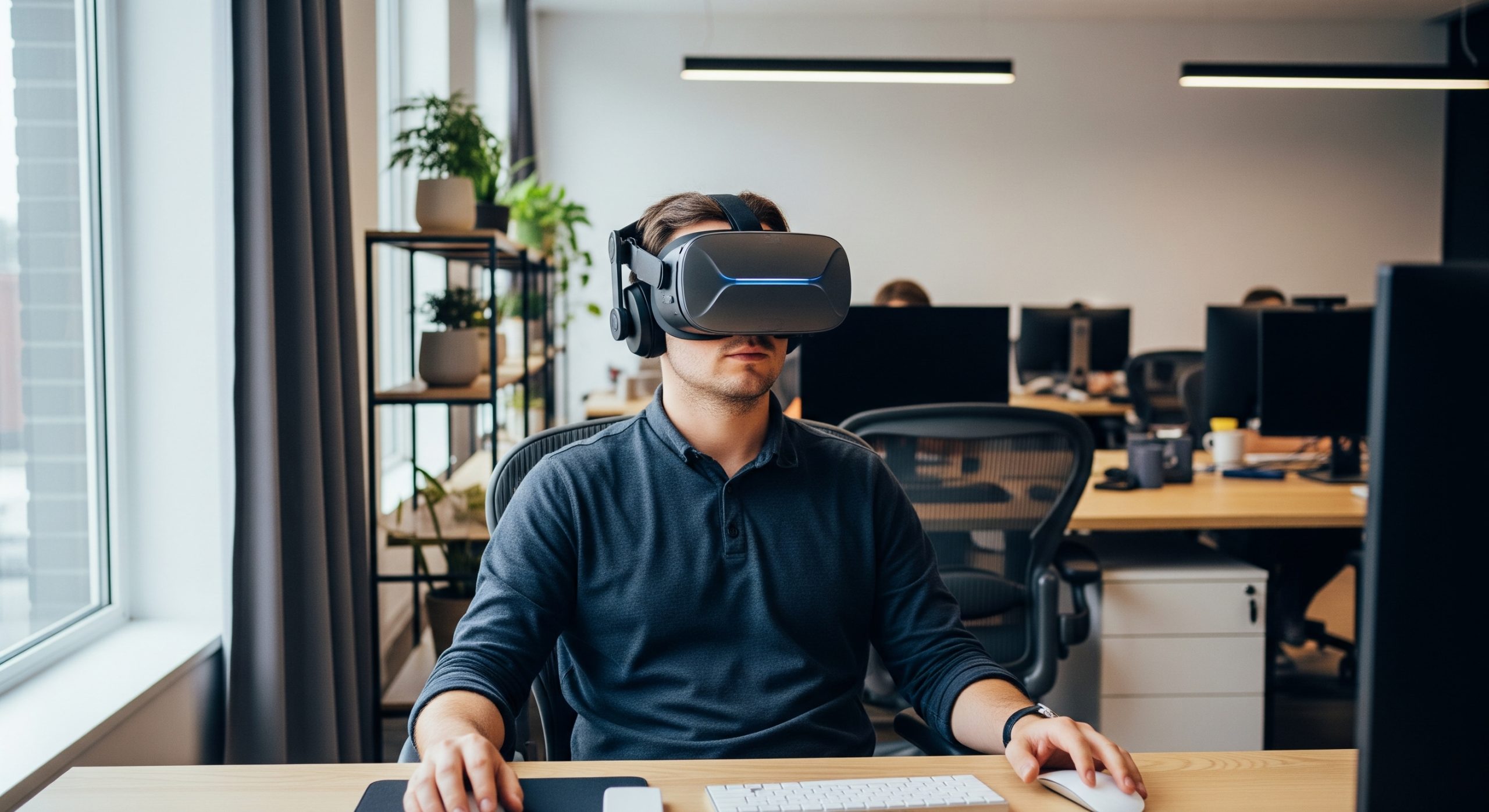
Unlike traditional e-learning or classroom sessions, VR creates a sense of presence, thanks to the feeling of actually being in a simulated environment. Users can look around, interact with objects, make decisions, and see the consequences of their actions in a controlled and risk-free setting.
How it works
- Hardware: Standalone headsets (like Meta Quest) or PC-connected systems
- Software: Pre-built or custom training modules for specific skills
- Management Platform: Tools to deploy content, track progress, and manage devices at scale
Why this matters for your team
When learners put on a headset, they stop passively consuming information and start actively building skills. Mistakes become learning opportunities, not safety hazards. Repetition builds muscle memory without boring instructors. And every action generates data that tells you exactly who is ready and who needs more practice.
Traditional training and communication don’t stick
Today's workforce is busy and easily distracted. Traditional classroom training and generic e-learning modules often turn into passive experiences where people attend physically but mentally tune out, as long, lecture-style sessions drain budgets and memories alike.
Employees sit through marathon workshops only to forget most of what they heard within days. Slide decks, manuals, and endless Zoom calls offer information, but they rarely change on-the-floor behavior. Workers skim pages instead of mastering tasks.
Teams scattered across regions are often distracted or simply not online at the same time. Without a unified, interactive platform, learning becomes fragmented and inconsistent. Such methods have created a number of problems for many learners over the years.
| Problem | Why It Matters |
| Passive learning | Slide decks and lectures don't change on-the-floor behavior |
| No safe practice space | High-stakes skills (emergency response, conflict resolution) can't be practiced safely |
| Inconsistent delivery | Different instructors = different quality; remote teams get left behind |
| No objective measurement | You can't track hesitation, error patterns, or decision-making |
| High disruption cost | Taking equipment offline or flying people to training centers is expensive |
When real-world practice is risky or prohibitively expensive, it gets skipped altogether. You wouldn’t let someone wire a live panel blindfolded but dry runs are often out of reach.
Soft skills and situational judgment cannot be fully understood through theory alone. You can’t role-play empathy or de-escalate a conflict through a bullet list; these abilities need practice, not PowerPoints.
VR delivers learning that’s hands-on, scalable, and hard to forget
With VR, employees learn by doing, not by watching another slide show. They slip on a headset and tackle tasks head-on flipping switches, navigating virtual shop floors, or resolving customer scenarios.
You can simulate real situations in a controlled space. Whether it’s a chemical spill, a critical sales pitch, or a hostile-workplace interaction, learners face lifelike challenges without any real-world risk. Many organizations standardize VR training modules to ensure every session meets stringent quality benchmarks.
Because VR can also live in the cloud, you can train teams anywhere from HQ to home offices while delivering identical quality every time. No more “Bob’s unique style” or time-zone headaches.
Behind the scenes, you measure performance in real time. Missed steps, hesitation points, and success rates all feed dashboards that spotlight skill gaps and mastery levels.
Best of all, VR builds confidence. Practicing high-stakes drills over and over cements muscle memory so when the pressure’s on, your team’s ready.
Use cases for virtual reality in the workplace
Onboarding and role familiarisation
New hires can explore their role before day one. Instead of rote policy lectures, they virtually navigate their actual workspace touring machines, meeting avatars of key colleagues, and running through common workflows. Immersive virtual tours of your facility help them understand the layout, while virtual job tryouts let candidates practice core tasks. And once hired, a dedicated VR onboarding solution makes their first week seamless.
Soft skills and leadership development
Conflict resolution, negotiation, and feedback don’t translate well from a checklist. In VR, learners step into realistic scenarios mediating between two arguing avatars or delivering constructive criticism to a simulated peer. They experiment with tone and timing, then instantly see how their approach changes outcomes.
Safety and compliance training
High-risk drills like fire evacuations or chemical spills can’t be practised on a live factory floor. VR recreates these emergencies in vivid detail, letting teams perfect response protocols without endangering people or property. Repeat until muscle memory takes over.
Customer service and frontline training
Tone, empathy, and objection handling are hard to coach via PowerPoints. VR immerses employees in customer interactions from irate callers to hesitant buyers so they build empathy and refine their pitch in a stress-free sandbox.
Cross-team collaboration
Distributed teams often miss out on shared learning experiences. VR brings everyone into the same virtual boardroom or project site, fostering camaraderie and collaboration. Whether planning a product launch or troubleshooting a process, remote colleagues work side by side no travel required.
Why VR training outperforms traditional methods
Higher retention through experiential learning
Studies show learners remember up to 75% of what they do, compared to just 5–10% of lecture-based material. By actively engaging the senses and emotions, VR forges stronger neural pathways turning “I saw it once” into “I know how to do it.”
Shorter time to competency
When trainees can repeat tasks instantly and receive immediate feedback, they learn more efficiently and confidently. In fact, VR learners completed training up to 4× faster than those in traditional classroom settings.
Consistent delivery, regardless of trainer or location
A single VR module guarantees the same high-quality experience for every participant. No more variability from different instructors, changing slides, or spotty Wi-Fi on remote calls.
Less disruption to operations
Traditional drills require downtime, travel, or pulling people off critical tasks. VR shifts those hours into virtual environments letting your factory floor hum, your stores serve, and your teams work while training runs in parallel.
Data-driven insights on performance and engagement
Every VR interaction is logged. From the choice points and reaction times, to the error rates and even eye movement. Those metrics transform gut-feel assessments into concrete analytics, helping you target coaching where it’s needed most.
Reduced long-term costs
While there's an upfront investment, VR training reduces ongoing costs dramatically, thanks to fewer travel and lodging expenses, reduced hours necessary for both instructors and trainees, and less operational downtime during training in terms of system shutdowns, which all in all can lead to significant return on investment.
VR workplace training use cases by industry
VR's strength is replicating real-world scenarios that are otherwise impractical, impossible, or unsafe to practice.
Manufacturing & industrial
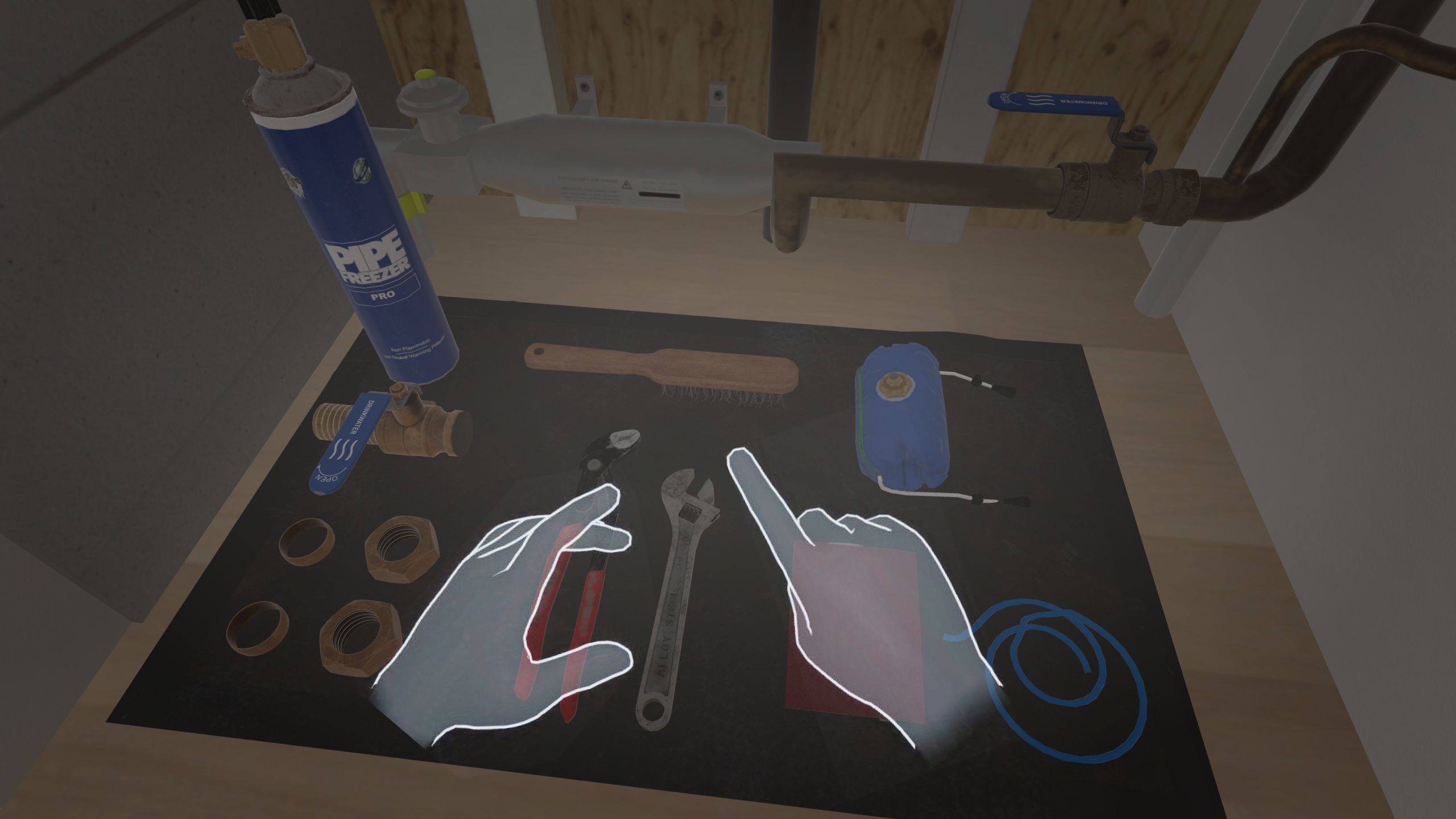
On the factory floor, every mistake can mean scraped materials, broken equipment, or lost production time. VR lets trainees practice assembly sequences, quality checks, and equipment operation as many times as needed, building speed and accuracy before they ever touch a live machine.
Construction & heavy equipment
Operating cranes, scaffolding, or heavy machinery leaves zero room for error. VR allows workers to practice complex maneuvers and identify site hazards in a completely risk-free environment. They can repeat difficult tasks until they feel confident, without exposing anyone to real danger.
Healthcare
Medical professionals must perform procedures perfectly under pressure, but patients aren't practice dummies. VR provides unlimited, repeatable surgical simulations and emergency response drills. Clinicians develop muscle memory and clinical judgment before stepping into an operating room.
Energy & offshore
Oil rigs, wind farms, and power plants operate in high-risk, hard-to-access environments. Shutting down for training costs millions. VR creates realistic simulations of equipment maintenance, safety drills, and emergency evacuations, enabling repeatable, measurable scenarios with zero operational downtime.
Retail & customer service
A calm Tuesday morning won't prepare your team for a holiday rush or an angry customer. VR immerses employees in realistic service scenarios: handling complaints, upselling under pressure, and managing long queues. They build emotional resilience and decision-making skills before facing real customers.
Corporate & soft skills
Leadership, negotiation, and conflict resolution can't be learned from a slide deck. VR places managers in realistic scenarios, delivering tough feedback, mediating disputes, or leading through change, with an AI-powered avatar reacting in real time. Practice changes behavior, not just knowledge.
Onboarding & orientation
New hires typically spend weeks absorbing policies before doing real work. VR changes that. They can virtually explore their workspace, meet avatar versions of key colleagues, and practice common workflows before day one. Time-to-productivity drops from weeks to days.
Safety & compliance
Most compliance training is a forgettable checkbox exercise. VR transforms it into memorable, scenario-based learning. Employees practice responding to fires, chemical spills, equipment malfunctions, or evacuation alerts, building instinctive reactions without any real-world risk.
VR use cases by industry
The sections above show how different industries use VR, but the pattern is to replace passive learning with active practice, measure what matters, and scale without losing quality.
| Industry | Best For | Example KPI Impact |
| Manufacturing | Assembly, equipment operation, quality control | 75% reduction in training time |
| Construction | Crane ops, hazard ID, fall protection | Fewer on-site incidents |
| Energy | Emergency drills, confined space entry | Zero-risk high-stakes practice |
| Retail | Customer service, sales, seasonal prep | 10-15% higher retention |
| Corporate | Leadership, negotiation, DEI | 97% higher confidence |
| All Industries | Safety & compliance onboarding | 80% 1-year retention |
No matter your industry, VR solves the same core problem, that practice is powerful, but real-world practice is often impossible, expensive, or risky. VR removes those barriers.
Is your company ready?
- You’re scaling fast and need onboarding that sticks.
- You’re bleeding time and money on ineffective slide decks.
- You want proof that people actually learn and apply new skills.
- You aim to modernise without overwhelming your teams.
If any of these sound familiar, VR could be the catalyst you’ve been waiting for.
How to implement VR workplace training in 6 steps
Rolling out VR training isn't a flip-the-switch task. Follow this proven framework to move from pilot to enterprise deployment.
Step 1: Identify your high-impact use case
Start with one area where faster onboarding, fewer errors, or safer practices deliver the biggest return. Common starting points:
- Safety training for high-risk roles
- New hire onboarding at scale
- Customer service skills for retail teams
- Equipment operation for manufacturing
Step 2: Choose off-the-shelf vs. custom content
| Approach | Best For | Timeline | Cost |
| Off-the-shelf | Common skills (safety, compliance, soft skills) | Days to weeks | Lower |
| Custom-built | Proprietary processes, unique equipment, brand-specific scenarios | 8–12 weeks | Higher |
Many companies start with pre-built modules to validate the approach, then invest in custom development once they've proven ROI.
Step 3: Select your hardware and platform
Hardware options:
- Standalone (Meta Quest series): No PC required, lower cost, easy to deploy. Best for most workplace training.
- PC-connected (Varjo, HTC Vive): Higher fidelity, better for design review or detailed technical work.
- Confirm your Wi-Fi or 5G network can handle streaming and real-time analytics, especially for cloud-rendered or high-fidelity content
Management platform: You'll need purpose-built XR device management to deploy content, track usage, and update headsets at scale.
Step 4: Run a pilot (6–8 weeks)
A focused pilot with 5–20 users will tell you what works before you scale. Ensure you have buy-in from HR, L&D, and IT before launch as early champions smooth procurement and troubleshooting.
During the pilot, track:
- Completion rates and time-to-complete
- User feedback and confidence scores
- Technical issues or friction points
- Integration with your LMS
Step 5: Measure and optimize
Use your pilot data to refine content, adjust difficulty, and fix technical issues. The data-driven training can be optimized further and provide extra value with precise measurements rather than guesswork. Remember to define your success metrics before the pilot, whether that is time-to-competency, error reduction, or trainee confidence, making ROI undeniable from day one.
Step 6: Scale across the organization
Once you've proven ROI, expand to additional teams, locations, and use cases. Organizations that scale successfully share one thing in common: they treat measurement as a day-one priority, not an afterthought.
Measuring success: the data-driven advantage
This is where VR training separates from every other method. Every interaction in VR can be logged and analyzed, allowing you to quickly see what works and how the trainees respond.
| Metric | What it tells you |
| Completion rates | Who finished training vs. dropped out |
| Time-to-complete | How efficiently learners progress |
| Attempts per task | Which skills require repetition |
| Error patterns | Where learners struggle most |
| Hesitation points | Which decisions cause uncertainty |
| Eye tracking | What learners paid attention to |
| Pre/post assessment scores | Objective knowledge gain |
Why measurement matters
Without visibility, VR training looks like a black box: learners go in, good feelings come out, but nothing concrete ties the program to business outcomes. And in the world of corporate budgets, "good feelings" don't unlock funding.
Companies that measure successfully can answer:
- Did this reduce workplace accidents?
- Are employees making fewer mistakes on the job?
- Which training modules actually improve performance?
- What's the exact ROI compared to traditional methods?
How to integrate with your LMS
VR training data can feed directly into your existing Learning Management System (LMS) or Business Intelligence tools. VR Owl can help with modules and custom platforms that can directly connect to your existing LMS, such as:
- LMS integration (SCORM/xAPI)
- Automatic data export to BI dashboards
- SOC 2 Type II compliance for security
Ready to transform your workplace training?
VR workplace training isn't about technology for technology's sake. It's about solving real business problems such as low retention, inconsistent delivery, high costs, and unsafe practice conditions.
Your team is ready to learn by actively doing instead of passively watching.
Contact VR Owl to discuss your VR training pilot