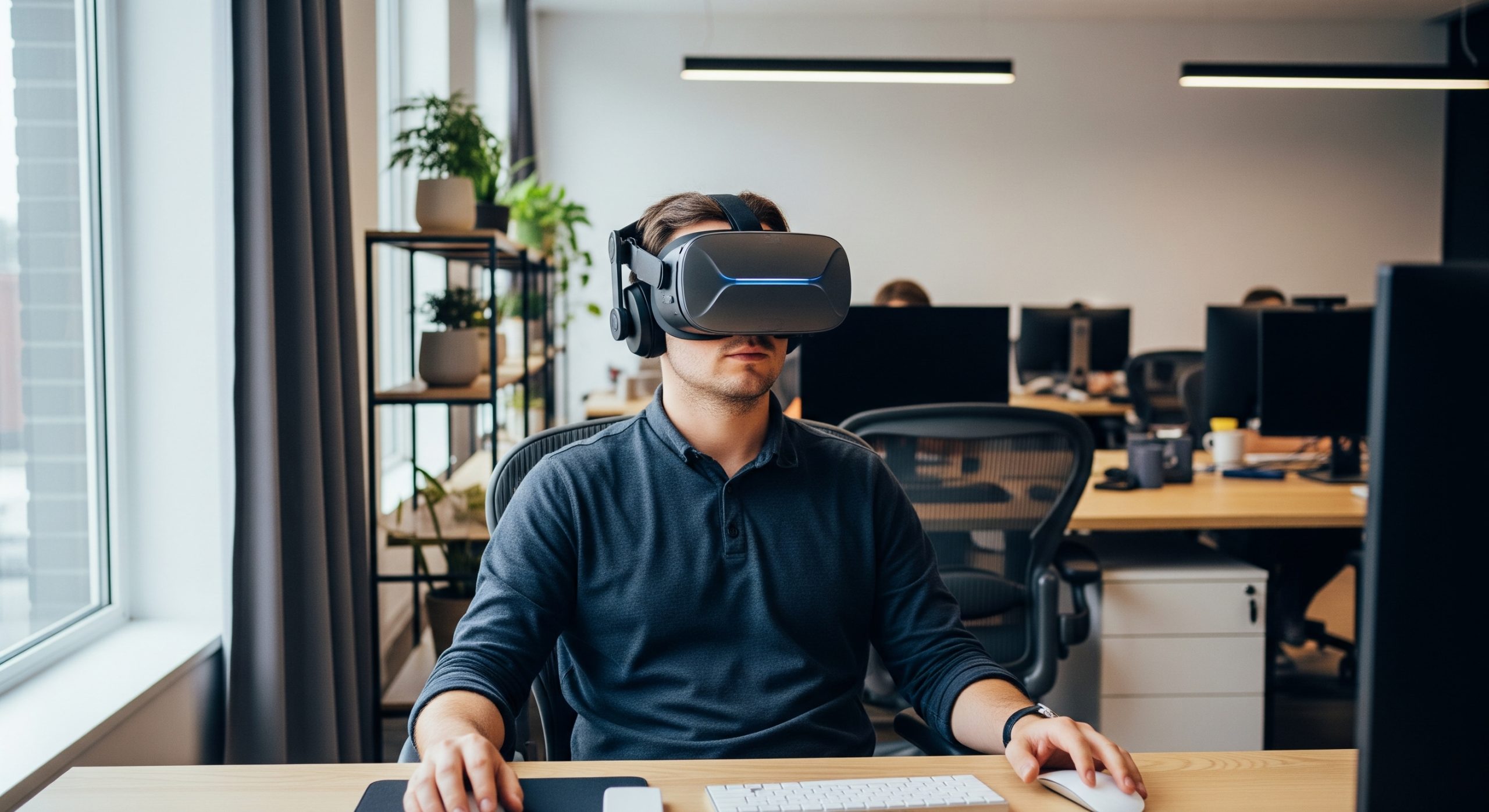
VR Construction Training: Why Teams Are Building Skills in Virtual Reality


Let's start with the obvious. The construction industry is plagued by labor shortages, budget overruns, and alarmingly high accident rates. On top of that, a generation of skilled workers is aging out, leaving firms shorthanded and prompting construction leaders to search for new solutions.
Say hello to virtual reality. It's shaking things up by offering new opportunities in the form of VR safety training and its high-tech cousins like augmented reality (AR). From VR construction training simulations to AR overlays, extended reality helps builders cut rework, improve safety, and collaborate smarter. This guide focuses on how VR construction training builds real skills - what it changes, where it pays off, and how to start.
Outdated processes are slowing down construction projects
Step onto most job sites today, and it feels like you're walking into a time warp. Labor shortages, budget overruns, rework, and communication breakdowns are still common headaches. In fact, the industry is notorious for delays and inefficiencies, with one report noting that poor communication alone is a factor in 57% of project failures.
The problem is clear. Traditional training methods just don't cut it anymore. They are failing to develop the critical skills that modern, complex sites demand, particularly in terms of training effectiveness and developing essential construction skills. Big projects often get bogged down in data, yet teams still rely on emailing PDFs and waiting for weekly site check-ins.
A 50-slide deck on trench safety can't replicate the visceral tension of seeing the walls of a virtual excavation start to crack and crumble, forcing the worker to identify the hazard and execute a safe escape under pressure. VR in construction, on the other hand, can drive employee engagement, build critical skills, and reflect the real-world challenges workers face in high-risk environments.
What virtual and augmented reality actually offer
So, what's the real magic trick that VR and AR have up their sleeves that your old tools can't touch? To put it simply, they create a richer way to experience and interact with project information, while allowing for visualisation of more complex procedures and concepts.
- Virtual reality immerses you in a simulated 3D environment. Put on a VR headset, and you can walk through a building before construction begins - seeing the space at full scale and examining details from any angle.
- Augmented reality takes a different approach by layering digital content onto the real world. Using a tablet, phone, or AR smart helmet, you can look at a physical job site and see virtual annotations or instructions overlaid on what's actually there.
There's also mixed reality (MR), which blends VR and AR elements, and the broader term extended reality (XR), that covers the whole spectrum of immersive environments.
Real-world applications in VR construction training
Companies are already using VR and AR to solve real construction challenges. Here are some of the most impactful VR applications in construction today.
Pre-construction walkthroughs with VR
One of VR's first big uses in construction was virtual design reviews. Rather than relying solely on blueprints or 3D models on a monitor, teams are doing full VR walkthroughs of projects before a single brick is laid. This helps both project teams and clients visualize the result in true scale and detail, guiding the direction and allowing for a more hands-on approach to project management.
Better safety training for workers
Construction sites are full of real-world risks, and while your workers might memorize the rulebook for operating a scissor lift on unstable ground, traditional training can't simulate the gut feeling of the platform swaying or the split-second decision needed to stabilize it. They walk into that real situation for the first time, unprepared for the adrenaline and the risk.
VR allows a new apprentice to gain hands-on experience without the deafening noise and visual chaos of a live steel erection, guiding a beam into place without the catastrophic consequence of a misstep that could cause serious injuries. They build muscle memory for the task in a risk-free environment with measurable training outcomes.
The results are measurable. In one NCCER and ABC Illinois evaluation, construction students who trained with VR scored 40% higher on their certification assessments than those taught the traditional way - a reminder that immersive practice translates into harder, testable skills, not just engagement.
Working at heights and fall prevention
Falls are the single biggest killer on construction sites, and they are exactly the kind of hazard that is impossible to rehearse safely in the real world. VR construction training puts workers on virtual scaffolding, ladders, and roof edges where they practice tying off, spotting unstable footing, and reacting to a slip - feeling the height and the consequence without ever leaving the ground. Repeating that scenario until the safe response is automatic is something no classroom or toolbox talk can match.
Smarter collaboration between teams and clients
Virtual simulations close the communication gap, putting teams inside the same project, quite literally, no matter where they are. The benefit is more immersive project reviews that enhance the overall experience for teams. Remote teams can all meet inside a virtual model of the project, regardless of where they are physically.
AR-assisted onsite workflows
While VR simulations excel in the office and training room, creating a controlled environment where workers can learn and explore, AR is also making significant strides in the field. Construction crews are starting to use AR tablets more intuitively, perhaps showing a welder the exact spot to place a steel joint, preventing a misaligned beam that could delay the project.
What firms are actually gaining
We know adopting VR and AR to prepare workers and ensure better knowledge retention is an investment. But here's the bottom-line question: what's the actual payback?
Shorter timelines and less rework on construction sites
A project manager doing a VR walkthrough can literally bump her virtual head on a pipe that's conflicting with the ceiling design - a clash that would have gone unnoticed on a 2D plan until the day of installation, forcing a costly re-route and delay. Contractors are seeing fewer change orders and RFIs thanks to that upfront alignment, and in turn, crews spend less time waiting or redoing work.
Reduced material waste and errors
A crew can use AR to visualize the entire layout of plumbing lines inside a slab before the pour, ensuring they don't accidentally order 100 extra feet of PVC that gets buried and wasted in concrete. When teams visualize the build in VR, they order what's needed more accurately, avoiding over-ordering or last-minute scrambles. An electrician using an AR tablet can look at a bare concrete wall and see the exact conduit path and outlet-box locations projected onto the surface, eliminating the 'oops' moment of drilling into rebar.
More satisfied clients
Construction clients often don't fully grasp what they're getting until it's built, and if it's not what they imagined, conflict arises. Instead of puzzling over blueprints, a client can put on a headset and experience the design directly - feeling the difference between a 10-foot ceiling and a 12-foot one, or seeing how the afternoon sun will glare off the glass lobby wall, all before a single foundation is poured.
Better safety outcomes for hazard recognition and high-risk tasks
Although the gains here are less directly financial, they are arguably the most important. A trainee wearing a VR headset can feel the heat and hear the crackle of a virtual flashover in a confined space, practicing their escape route until it becomes instinct, not theory. With immersive learning in electrical safety, fire safety, confined space entry, hot work operations, and other safety protocols, incident rates tend to drop.
What's still in the way of construction VR training programs
If VR and AR are such game-changers, why isn't every single site using them? New tech still has some kinks to iron out, and there are a few real hurdles to tackle.
Cost and accessibility
Now for the elephant in the room: cost. Yes, VR isn't free, but neither are constant delays and rework. High-end VR setups and custom software can be expensive, which has been a barrier for smaller companies. Although hardware prices are coming down, the initial investment is still significant - a company might need several headsets plus a powerful PC for developing content or running complex models.
Workflow integration
For XR technology to really take off, it needs to plug smoothly into existing construction environments. VR must work with your BIM software - complex model imports that busy teams won't bother with are a non-starter. Similarly, AR tools need to integrate with project management systems and drawings, or they're just another app to juggle.
Training and onboarding
You can buy all the tech in the world, but if your crew doesn't know how to use it, it's just a paperweight. Picture a veteran foreman in a virtual boiler room, practicing identifying valves and emergency shut-offs until it becomes second nature. This helps him build confidence, improve problem-solving skills, and prepare for emergency scenarios in dangerous environments.
Some crew members resist - they're less tech-savvy or stuck in their ways. That means identifying a site lead who can troubleshoot a headset and coach a skeptical bricklayer through his first VR session, showing him how to practice a complex corner detail before ever touching a mortar board.
What's coming next in XR for the construction industry
Believe it or not, we're only just scratching the surface of what's possible with VR and AR in construction. Extended reality's future looks even more connected and intelligent. Here are a few developments on the horizon.
Deeper integration of VR with Building Information Modeling
So far, VR has been used to view static models, but the next step is embedding live project data into those virtual environments. Imagine a VR walkthrough of your building where you can toggle on the construction schedule or see cost data tied to each element. This VR + BIM mashup lets project managers visualize the construction sequence or cost impacts in real time as they virtually tour the project.
Generative AI for rapid modeling
One bottleneck for creating VR content has been the time and skill required to produce detailed 3D models. Generative AI is poised to change that. We're starting to see AI tools that can take 2D plans or basic parameters and automatically generate 3D models or even VR environments.
Cloud-based collaboration and XR anywhere
As networks and cloud computing improve, VR and AR will become more mobile and interconnected. We're already seeing cloud platforms where multiple users join the same VR session from anywhere in the world. Soon, teams might not even need a powerful on-site computer, as the heavy graphics processing could happen in the cloud, streaming the experience to a lightweight headset.
Construction companies already using this tech
Large industry players focused on innovation are investing heavily in construction tech. For instance, Cemex Ventures, the venture arm of global building-materials company Cemex, has been actively backing startups that use VR and AR to improve construction efficiency.
Another example is PCL Construction, which partnered with a VR software startup to roll out company-wide VR safety training for its workforce. Skanska and Balfour Beatty, two of the world's largest construction firms, have also integrated VR training modules into their safety programs to reduce incident rates. You can read more about VR in construction case studies here.
Want to future-proof your projects?
Forget seeing VR as a sci-fi novelty. For leading firms, it's now a practical, non-negotiable tool in their toolkit. So how can your organization start taking advantage and avoid being left behind? Here are a few action steps.
- Start with a specific, high-impact use case. Rather than overhauling everything at once, pick one area that could greatly benefit from XR. Safety training and client presentations are proven starting points.
- Track the ROI and outcomes. Define what success looks like - fewer incidents, faster training times, reduced change orders - and then measure it to build internal support.
- Choose a platform that fits your tech stack. Look for construction VR software and AR tools that import your BIM models or connect with your project management systems with minimal manual effort.
Ready to cut rework and boost safety with immersive training? VR Owl specializes in virtual reality training solutions for construction teams. From bespoke VR training modules and safety modules covering hazard identification to drills for fall protection, we give workers the skills they need to succeed.